
You already know cardio is part of the weight-loss equation. The argument you keep running into is which kind.
HIIT High-Intensity Interval Training has dominated fitness headlines for the past decade, promising maximum fat burn in minimum time.
Steady-state cardio, the quieter sibling, has been around forever and still fills every treadmill at the gym on Monday mornings.
So, which actually wins for fat loss?
The honest answer: it depends on your body, your schedule, and how long you can actually stick with a routine.
This article breaks down the real science behind both so you can stop guessing and start burning.
What Is HIIT?
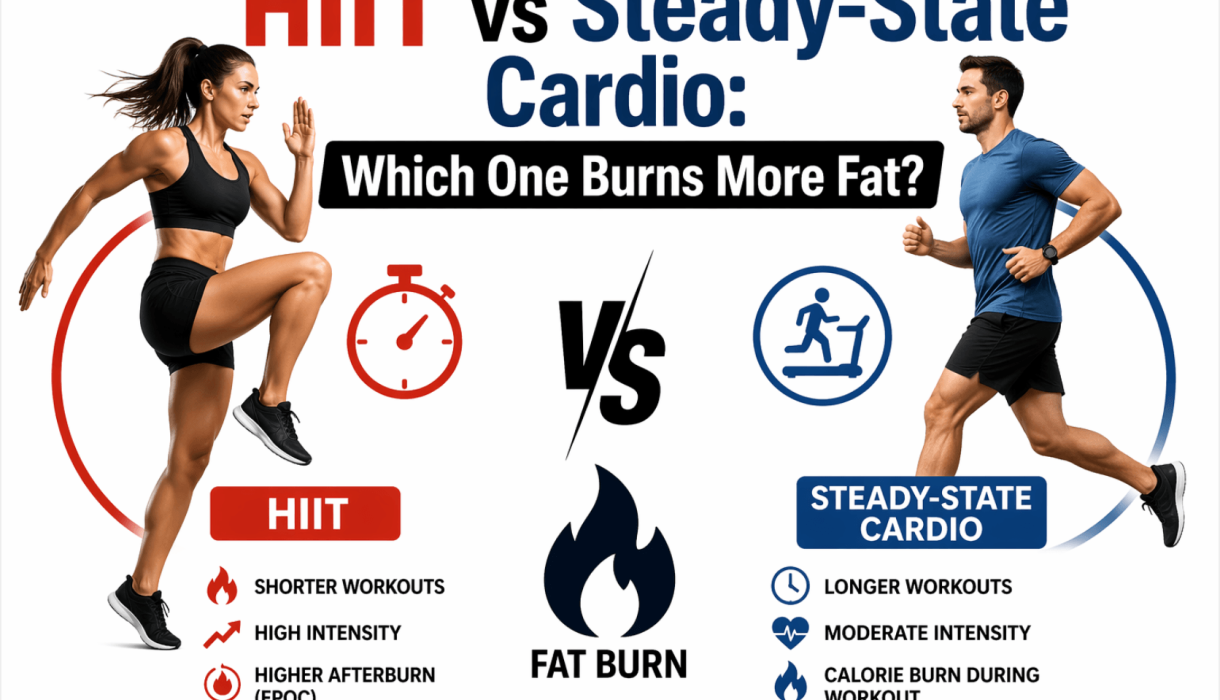
HIIT stands for High-Intensity Interval Training. It alternates short bursts of maximum-effort exercise with brief recovery periods.
A classic HIIT session might look like this.
- 30 seconds sprinting at 90% effort.
- 60 seconds walking or slow jogging.
- Repeat for 15–25 minutes.
The work-to-rest ratio varies, but the defining feature is that the “work” intervals push you close to your max heart rate — typically 80–95% of your maximum heart rate.
HIIT can be done with almost any movement: sprinting, cycling, jumping rope, kettlebells, rowing, or bodyweight circuits.
Typical session length: 15–30 minutes
Effort level: High to very high
Experience required: Beginner-friendly versions exist, but it demands a fitness base for the intense formats
What Is Steady-State Cardio?
Steady-state cardio (also called LISS, Low-Intensity Steady State) means exercising at a consistent, moderate intensity for an extended period.
Examples include
- A 45-minute brisk walk.
- A 30-minute jog at a conversational pace.
- Cycling at a comfortable speed for an hour.
- Swimming laps at a steady rhythm.
Your heart rate stays in the moderate zone, roughly 60–70% of your maximum heart rate, and you sustain that effort throughout the session without major spikes or drops.
Typical session length: 30–60+ minutes
Effort level: Low to moderate
Experience required: Suitable for all fitness levels, including absolute beginners
HIIT vs Steady-State Cardio: The Core Differences
| Factor | HIIT | Steady-State Cardio |
|---|---|---|
| Session length | 15–30 min | 30–60+ min |
| Intensity | High (80–95% max HR) | Moderate (60–70% max HR) |
| Calories burned per session | Moderate–High | Moderate |
| Post-workout calorie burn | High (afterburn effect) | Low |
| Recovery needed | 48 hours between sessions | Can do daily |
| Joint stress | Higher | Lower |
| Best for | Time-crunched people, intermediate+ | Beginners, high volume training, active recovery |
Calories Burned: The Raw Numbers
Let’s look at what the research actually says about calorie burn.
A 155-pound (70 kg) person performing 30 minutes of vigorous HIIT burns approximately 400–500 calories. The same person doing 30 minutes of moderate-pace jogging burns roughly 250–300 calories.
On paper, HIIT looks like a clear winner.
But here’s the wrinkle: HIIT sessions are typically shorter than steady-state sessions.
If you compare a 20-minute HIIT workout against a 45-minute steady-state walk or jog, the total calorie burn starts to equalize, or steady-state can even come out ahead, depending on the effort level.
The smarter comparison is calories burned per unit of time invested, not raw session totals.
The Afterburn Effect (EPOC): HIIT’s Real Advantage
HIIT’s biggest metabolic edge isn’t the calories you burn during the workout, it’s the calories you burn after.
This is called EPOC: Excess Post-Exercise Oxygen Consumption. After a high-intensity session, your body works harder than normal to restore itself to a resting state. Heart rate comes down, oxygen debt is repaid, muscles repair, and body temperature normalizes all of which require energy.
Studies show HIIT can elevate your metabolism for 24 to 48 hours after a session. Some research estimates that the afterburn adds 6–15% of total calories burned on top of what you burned during exercise.
For steady-state cardio, the EPOC effect exists but is significantly smaller, typically just 1–3 hours of slightly elevated metabolism post-workout.
Over weeks and months, this afterburn difference adds up. It’s one of the reasons HIIT tends to produce comparable or greater fat-loss results in shorter overall training time.
Fat Oxidation: Does “Fat-Burning Zone” Actually Work?
You may have heard that lower-intensity exercise burns a higher percentage of fat for fuel, and this is technically true.
During steady-state cardio in the 60–70% heart rate zone, your body preferentially uses fat as its primary energy source.
During HIIT, your body relies more heavily on glycogen (stored carbohydrates) because the intensity demands faster-burning fuel.
This is the science behind the so-called “fat-burning zone” on cardio machines.
But here’s the problem with that logic: the percentage of fat burned doesn’t equal total fat burned.
If you burn 300 calories at 60% from fat, you’ve burned 180 fat calories. If you burn 500 calories at 40% from fat, you’ve burned 200 fat calories plus you get the EPOC effect on top.
Total calorie deficit drives fat loss, not the fuel source used during exercise. Both approaches get you there. HIIT just tends to do it faster per minute of exercise.
Muscle Preservation: Which Cardio Protects Your Gains?
This matters whether you’re actively lifting weights or simply trying to lose fat without looking “skinny-fat” at your goal weight.
Excessive steady-state cardio, especially at high volumes (think: 60+ minutes daily, every day), can increase cortisol, blunt muscle protein synthesis, and, over time, contribute to muscle loss. This is especially relevant if you’re already in a calorie deficit.
HIIT, because of its similarity to resistance training (short, intense effort + rest), tends to be more muscle-sparing.
Some studies even show that HIIT can support lean muscle maintenance in a way that long-duration cardio cannot.
Practical takeaway: If you’re lifting weights and cutting calories simultaneously, HIIT is generally the better choice for preserving your muscle mass while losing fat.
Who Should Choose HIIT?
HIIT is likely your better option if.
- You’re time-crunched. A 20-minute HIIT session 3x per week can match or beat an hour of daily moderate cardio for fat loss results.
- You’ve hit a plateau. The metabolic demand of HIIT can reignite fat loss when steady-state cardio has stopped producing results.
- You want to preserve muscle. Especially relevant if you’re strength training alongside your cardio.
- You enjoy variety and challenge. HIIT workouts are structurally varied, which many people find more engaging than repetitive steady-state sessions.
Caution: HIIT is not ideal if you have joint issues (knees, hips, ankles), are significantly overweight and at risk of injury, or are brand new to exercise and haven’t built a basic fitness foundation. Start where you are not where you think you should be.
Who Should Choose Steady-State Cardio?
Steady-state cardio is likely your better option if.
- You’re a beginner. Walking 10,000 steps a day, cycling at a gentle pace, or swimming leisurely is sustainable and still very effective for weight loss when you’re starting.
- You have joint pain or injury. Low-impact steady-state options like walking, cycling, or swimming are much gentler on the body.
- You’re doing heavy strength training. Adding HIIT on top of demanding resistance training leads to excessive systemic fatigue. Steady-state cardio is the smarter complement.
- You find it enjoyable and stress-reducing. Exercise psychology matters. The best workout is one you’ll actually do consistently. If a long walk or swim is something you look forward to, that behavioral edge outweighs theoretical calorie math.
- You need active recovery. Low-intensity cardio on rest days promotes blood flow and recovery without adding recovery debt.
Can You Do Both? (The Hybrid Approach)
Absolutely, and for most people pursuing sustainable fat loss, this is the most practical strategy.
A sample weekly structure.
- Monday: HIIT session (20–25 min)
- Tuesday: Steady-state walk (45 min) or rest
- Wednesday: HIIT session (20–25 min)
- Thursday: Steady-state cardio (30–45 min)
- Friday: HIIT or strength training
- Saturday: Long walk, hike, or bike ride (low intensity)
- Sunday: Rest or gentle movement
This approach lets you get the metabolic benefits of HIIT while using steady-state sessions for active recovery and additional calorie burning without piling on recovery stress.
What the Research Actually Shows
The scientific literature on HIIT vs steady-state cardio for fat loss is genuinely nuanced and marketers on both sides cherry-pick the studies that support their preferred narrative.
Here’s a fair summary of what peer-reviewed research indicates.
HIIT produces equal or superior fat loss results in less time. Multiple meta-analyses have confirmed that HIIT and moderate-intensity continuous training (MICT) produce similar reductions in body fat percentage, but HIIT achieves this in sessions that are 40–60% shorter in duration.
Both are effective when adherence is maintained. Several studies show HIIT dropout rates are higher than steady-state cardio, particularly in overweight or older populations. A workout that gets skipped is worth zero calories.
HIIT delivers additional cardiovascular and metabolic benefits. Improvements in VO2 max (cardiovascular fitness), insulin sensitivity, and blood pressure tend to be greater with HIIT, which matters beyond just fat loss.
Individual response varies significantly. Some people respond better to HIIT, others to steady-state genetics, fitness base, lifestyle stress load, and sleep; all influence this.
Practical Tips to Maximize Results from Either Approach
Regardless of which cardio style you choose, these fundamentals determine your results more than HIIT vs LISS ever will.
1. Consistency over intensity. Showing up four times a week for moderate sessions beats doing two brutal HIIT workouts followed by a week of burnout.
2. Protect your calorie deficit. Cardio burns calories, but it also stimulates appetite. Be mindful of “earning” food with exercise as a mental trap that erases your deficit.
3. Prioritize sleep. Poor sleep increases cortisol and hunger hormones, undermining fat loss regardless of your cardio protocol.
4. Track your progress correctly. Don’t just track weight — track body measurements, energy levels, and how clothes fit. The scale doesn’t distinguish between fat loss and muscle gain.
5. Progress over time. Whether you choose HIIT or steady-state, gradually increasing the demand (longer sessions, harder intervals, more weekly volume) is what produces continued results.
HIIT vs Steady-State Cardio: The Verdict
There’s no universal winner. But here’s a practical framework.
- Start with steady-state if you’re new to exercise, dealing with injury, or simply building the habit. Walking, cycling, and swimming get you moving, protect your joints, and establish consistency.
- Incorporate HIIT once you have a fitness base, when time is your limiting factor, or when your fat-loss results have stalled.
- Use both together for the most flexible, sustainable, and effective long-term approach.
The question isn’t really which cardio is best; it’s which one will you actually do, week after week, for months on end? That’s the cardio that burns the most fat.
Frequently Asked Questions
Is HIIT better than steady-state cardio for belly fat?
Both reduce overall body fat, including belly fat. HIIT tends to produce greater reductions in visceral (deep belly) fat in research studies, partly due to its hormonal effects on insulin sensitivity and growth hormone release.
However, spot-reduction is a myth you can’t target belly fat specifically through any cardio type. Total fat loss from a sustained calorie deficit is what reduces belly fat.
How many days a week should I do HIIT?
2–3 sessions per week is the standard recommendation for most people. HIIT places significant recovery demand on the body, and doing it daily increases injury risk and can lead to overtraining.
Can beginners do HIIT?
Yes, but with modifications. True all-out HIIT requires a fitness base. Beginners can start with interval walking (fast walk / slow walk alternations) and gradually build intensity over weeks before progressing to more demanding formats.
Does steady-state cardio burn muscle?
At moderate volumes, no. Excessive steady-state cardio (hour-long sessions daily in a deep calorie deficit) can contribute to muscle loss over time, particularly if protein intake is insufficient.
Keeping protein high (0.7–1g per pound of bodyweight) and limiting extreme volumes protects muscle during fat loss.
Which cardio is better if I’m also lifting weights?
HIIT and heavy lifting together can create excessive recovery demand — use this combination carefully.
Many lifters prefer steady-state cardio (especially walking) as their primary fat-loss cardio because it adds calorie burn without competing with strength adaptations.
Ready to put your cardio to work? Check out our guide to belly fat exercises and how walking 20,000 steps a day can transform your body, no gym required.
Author note
This article is for informational purposes only and does not constitute medical or professional fitness advice. Consult a healthcare provider before beginning any new exercise program.