The Protein Cheat Sheet: How Much You Actually Need to Lose Fat
Posted in :

If you’ve ever Googled “How much protein do I need,” you’ve probably landed on a dozen different answers, some alarmingly low, some suspiciously high.
Here’s the truth: protein intake is the single most powerful nutrition lever you can pull when trying to lose fat without losing muscle.
This guide cuts through the confusion. Below you’ll find a simple, science-backed protein cheat sheet with exact targets for different body types, goals, and activity levels plus the best food sources and the common mistakes that quietly sabotage fat loss.
Whether you’re just starting a calorie deficit or you’ve been dieting for months and your progress has stalled, getting your protein right is the fastest, most reliable fix you’re probably overlooking.
Why Protein Is the MVP of Fat Loss
Most people think of protein as a muscle-building nutrient, something for gym people who drink chalky shakes. But protein plays an equally critical role in fat loss, and the science is unambiguous.
Here’s what adequate protein actually does when you’re in a calorie deficit:
The Science-Backed Benefits
Preserves lean muscle mass
During a calorie deficit, your body can cannibalize muscle for energy. Higher protein intake signals your body to spare that muscle and burn fat instead.
Increases satiety
Protein is the most satiating macronutrient. Studies consistently show that high-protein diets reduce hunger hormones like ghrelin and increase fullness signals, making it easier to eat less without feeling deprived.
Boosts metabolism via the thermic effect
Your body burns more calories digesting protein (20–30% of its calories) than it does digesting carbs (5–10%) or fat (0–3%).
Prevents the “skinny fat” outcome
Losing weight without adequate protein often means losing muscle along with fat, leaving you lighter but softer, with a slower metabolism.
A landmark 2012 study published in the FASEB Journal found that participants who ate twice the RDA of protein while in a calorie deficit lost significantly more fat and retained significantly more muscle than those who ate the standard amount. The results have been replicated dozens of times since.
The Official RDA vs. What You Actually Need
The official Recommended Dietary Allowance (RDA) for protein is 0.8 grams per kilogram of body weight per day (about 0.36 g per pound).
This number is not wrong, but it’s designed to prevent protein deficiency in sedentary adults, not to optimize body composition.
If you’re trying to lose fat, you need significantly more. Here’s why: the RDA was established as a minimum threshold, not an optimal target.
Think of it like the minimum wage; it keeps you from poverty, but it’s not what you’d aim for.
⚠️ Important Distinction
When calculating your protein needs for fat loss, use your goal body weight or lean body mass, not your current weight.
If you’re significantly overweight, basing protein on total body weight will overestimate your actual needs because excess fat tissue doesn’t require protein to be maintained.
The Protein Cheat Sheet: Your Exact Daily Targets
Use the table below to find your recommended daily protein range based on your activity level and goal.
These ranges are drawn from the research consensus of sports dietitians, exercise scientists, and clinical nutrition trials.
Daily Protein Targets for Fat Loss
| Your Situation | Target (per lb of goal weight) | Target (per kg) | Level |
|---|---|---|---|
| Sedentary, mild deficit | 0.6 – 0.75g | 1.3 – 1.65g | Starter |
| Moderately active (2–3x/week) | 0.7 – 0.85g | 1.55 – 1.9g | Moderate |
| Active (4–5x/week, cardio + weights) | 0.8 – 1.0g | 1.8 – 2.2g | Active |
| Very active / endurance athlete | 0.9 – 1.1g | 2.0 – 2.4g | High |
| Strength training / muscle preservation priority | 1.0 – 1.2g | 2.2 – 2.6g | Elevated |
| Aggressive deficit / lean individuals | 1.1 – 1.3g | 2.4 – 2.8g | High Priority |
= Your Daily Protein Target (grams)
For most people trying to lose fat without losing muscle, landing anywhere between 0.8g and 1.0g of protein per pound of goal body weight is the sweet spot.
It’s high enough to preserve muscle, trigger satiety, and keep your metabolism humming without being so extreme that it crowds out other important nutrients.
How to Hit Your Protein Target Every Day
Knowing your target is step one. Actually hitting it consistently is where most people fall short. The simplest strategy: anchor each meal around a protein source, then build the rest of your meal around it.
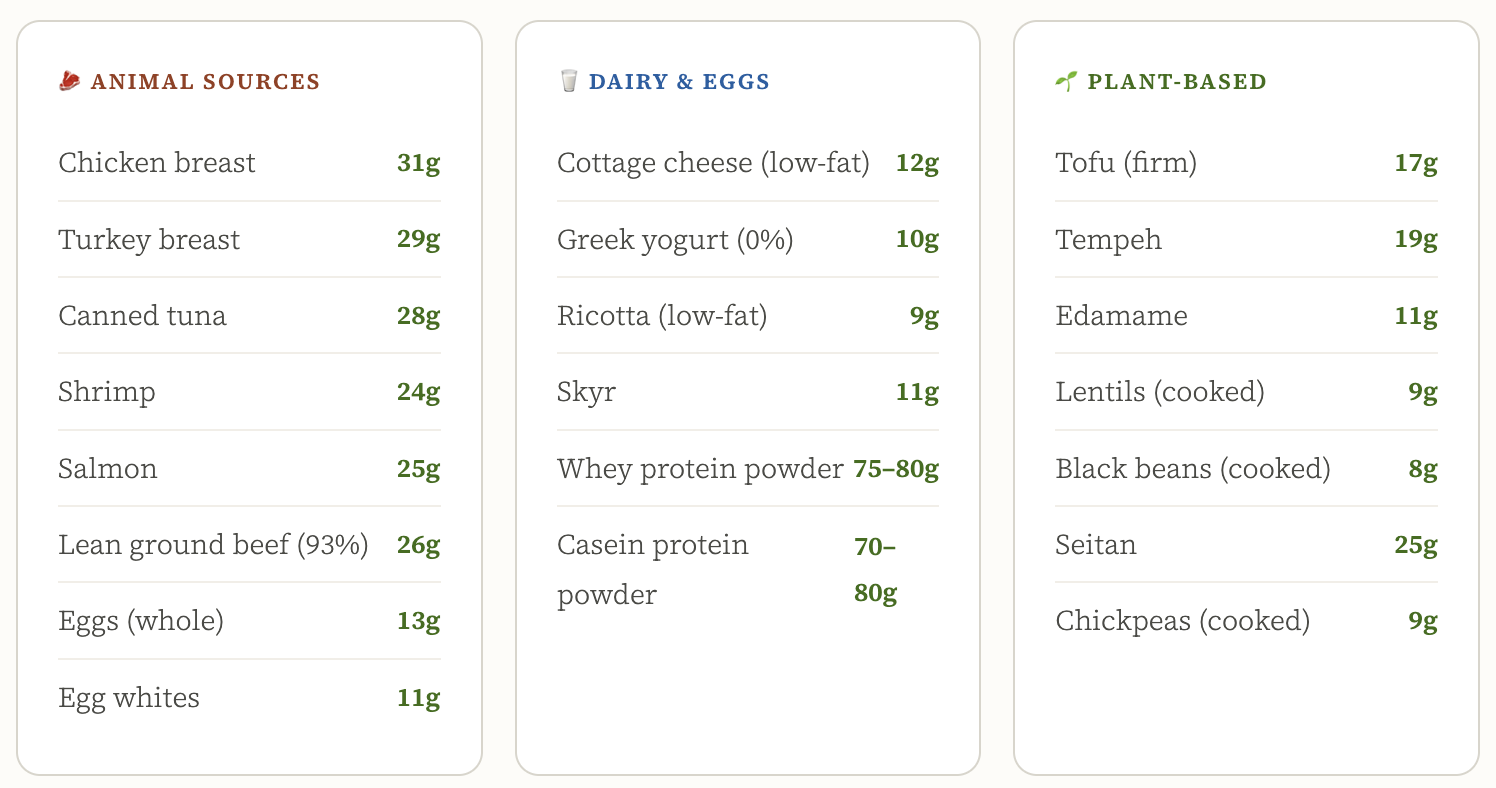
Best Protein Sources, Ranked by Protein Density
These are grams of protein per 100g (3.5 oz) of food. Prioritize sources with a high protein-to-calorie ratio when you’re in a deficit.
💡 Pro Tip: Protein Distribution Matters
Research shows that spreading your protein across 3–4 meals of 30–50 g each maximizes muscle protein synthesis throughout the day far more effectively than eating all your protein in one or two sittings. Aim for a protein anchor at every meal, not just dinner.
Protein Myths That Are Quietly Hurting Your Progress
Misinformation about protein is everywhere. Let’s dismantle the most persistent myths with what the evidence actually says.
Myth: Eating more than 30g of protein per meal is wasted
The “30g rule” is a simplification based on early muscle protein synthesis research. More recent studies show the body can utilize larger amounts, especially in active individuals or those eating less frequently. Your kidneys don’t “overflow”; excess protein absorption simply takes longer.
Myth: High-protein diets damage your kidneys
In people with healthy kidneys, there is no credible evidence that high protein intake causes damage.
This concern applies only to people with pre-existing kidney disease. The American Dietetic Association confirms that high-protein diets are safe for healthy adults.
Myth: You need protein shakes to hit your targets
Protein powders are a convenient tool, not a requirement. Whole food sources like chicken, Greek yogurt, eggs, and fish are nutritionally superior and more satiating. Use shakes when convenience matters, not as a crutch.
Myth: Plant protein is significantly inferior to animal protein
While plant proteins are often lower in certain essential amino acids and have lower bioavailability, this is easily overcome by eating a variety of plant protein sources and consuming slightly higher amounts. A well-planned plant-based diet provides plenty of protein for fat loss.
Truth: Protein helps you eat less without trying
This one is real. High-protein meals reduce ghrelin (the hunger hormone) and increase PYY and GLP-1 (satiety hormones).
People on high-protein diets consistently report eating fewer calories spontaneously without counting or restricting. Protein is essentially nature’s appetite suppressant.
Sample High-Protein Day: 150g Protein Blueprint
Here’s what a 150 g protein day actually looks like in practice, no supplements required, no complicated meal prep.
🍳 Breakfast: ~40g Protein
3 whole eggs scrambled + 3 egg whites + 1 cup cottage cheese (low-fat) + black coffee
🥗 Lunch: ~45g Protein
170g grilled chicken breast + large salad with chickpeas, cucumber, tomato, olive oil + water
🍽️ Dinner: ~45g Protein
200g baked salmon + 1 cup edamame + steamed broccoli + ½ cup cooked quinoa
🥣 Snack: ~20g Protein
1 cup Greek yogurt (0% fat) + handful of almonds
This day totals approximately 150 g of protein at roughly 1,800–2,000 calories, a modest deficit for most adults, without requiring any protein supplements or obsessive tracking.
FAQ: About Protein Cheat Sheet and Fat Loss
Can I eat too much protein and gain fat?
Technically, any macronutrient in excess of your total calorie needs can contribute to fat gain but protein is the hardest to overeat, the least likely to be stored as fat, and the most metabolically costly to digest.
In practice, very few people gain fat from eating too much protein. The risk is almost always from excess calories total, not excess protein specifically.
Does protein timing matter, like eating it before or after exercise?
For fat loss purposes, total daily protein is far more important than timing. That said, consuming 20–40g of protein within 1–2 hours post-workout can support muscle protein synthesis and recovery.
If you exercise in the morning, prioritize a protein-rich breakfast. But don’t stress over exact timing if you’re consistently hitting your daily target.
Should I eat more protein on days I don’t work out?
Your body continues to rebuild and repair muscle on rest days, so maintaining your usual protein intake on non-training days is beneficial.
Some research even suggests slightly elevated protein on rest days may improve recovery outcomes.
At the very least, don’t slash your protein on days you rest. The muscle-sparing work continues whether you’re in the gym or not.
I’m over 50, do I need more protein?
Yes. Older adults experience a phenomenon called anabolic resistance, meaning the muscle-building response to protein becomes less efficient with age.
Research in older adults generally recommends 1.0–1.2g per kilogram of body weight as a minimum, with some evidence supporting even higher amounts to counter age-related muscle loss (sarcopenia).
If you’re over 50 and trying to lose fat, err toward the higher end of your protein target range.
What’s the best protein source for fat loss specifically?
Lean animal proteins, such as chicken breast, turkey, white fish, egg whites, and low-fat dairy, offer the highest protein-per-calorie ratio, making them ideal for a calorie deficit.
Among all options, non-fat Greek yogurt, cottage cheese, and canned tuna consistently rank among the most effective for fat loss because they’re filling, nutrient-dense, and very low in fat calories.
Key Takeaways: Protein Cheat Sheet
- The RDA is not enough for fat loss. 0.8g/kg keeps you from deficiency, but it doesn’t optimize body composition.
- Target 0.8–1.0g per pound of goal body weight for most active people in a calorie deficit.
- Protein preserves muscle, kills hunger, and boosts metabolism. It’s the most powerful tool in a fat-loss diet.
- Spread protein across 3–4 meals of 30–50g each for maximum muscle-sparing benefit.
- Whole foods first, protein powder as a convenient supplement, not a replacement for real food.
- If you’re over 50, lean and active, or in an aggressive deficit aim for the higher end of your range.
Bottom Line
Protein is the single most impactful nutrition variable for people trying to lose fat without sacrificing muscle.
Yet most people chronically under-eat it, then wonder why they feel hungry, lose strength, or plateau after a few weeks of dieting.
Use this cheat sheet as your reference point. Find your target range, anchor every meal around a quality protein source, and distribute your intake evenly throughout the day.
These three habits alone will outperform most complicated diets, detoxes, and expensive supplements.
Fat loss isn’t magic. But protein comes close.
Disclaimer.
This article is based on peer-reviewed nutritional science and clinical guidelines. Always consult a registered dietitian or healthcare provider before making significant changes to your diet, especially if you have existing health conditions.