


It’s one of the most debated questions in fitness. The honest answer depends on what you mean by “burn more fat,” and the science reveals a more nuanced story than either camp admits.
How Your Body Actually Burns Fat
Before declaring a winner, it helps to understand what “burning fat” actually means.
Fat loss occurs when your body is in a sustained caloric deficit, consuming fewer calories than it expends.
Your body then draws on stored triglycerides in fat cells, breaks them down through a process called lipolysis, and oxidizes the resulting fatty acids for fuel.
Exercise accelerates this process in two ways: by burning calories directly during the workout, and by increasing the rate at which your body burns calories at rest.
Both cardio and strength training trigger fat burning but they do so through very different mechanisms, and on very different timelines.
Key concept
You cannot “spot reduce” fat from a specific body part. When you lose fat, you lose it systemically.
Genetics and hormones determine where it comes off first. No amount of crunches will specifically burn belly fat.
The Case for Cardio
Cardiovascular exercise running, cycling, swimming, and rowing, has long been the go-to prescription for fat loss, and the reasoning is straightforward: it burns a lot of calories, fast.
Calorie burn per session
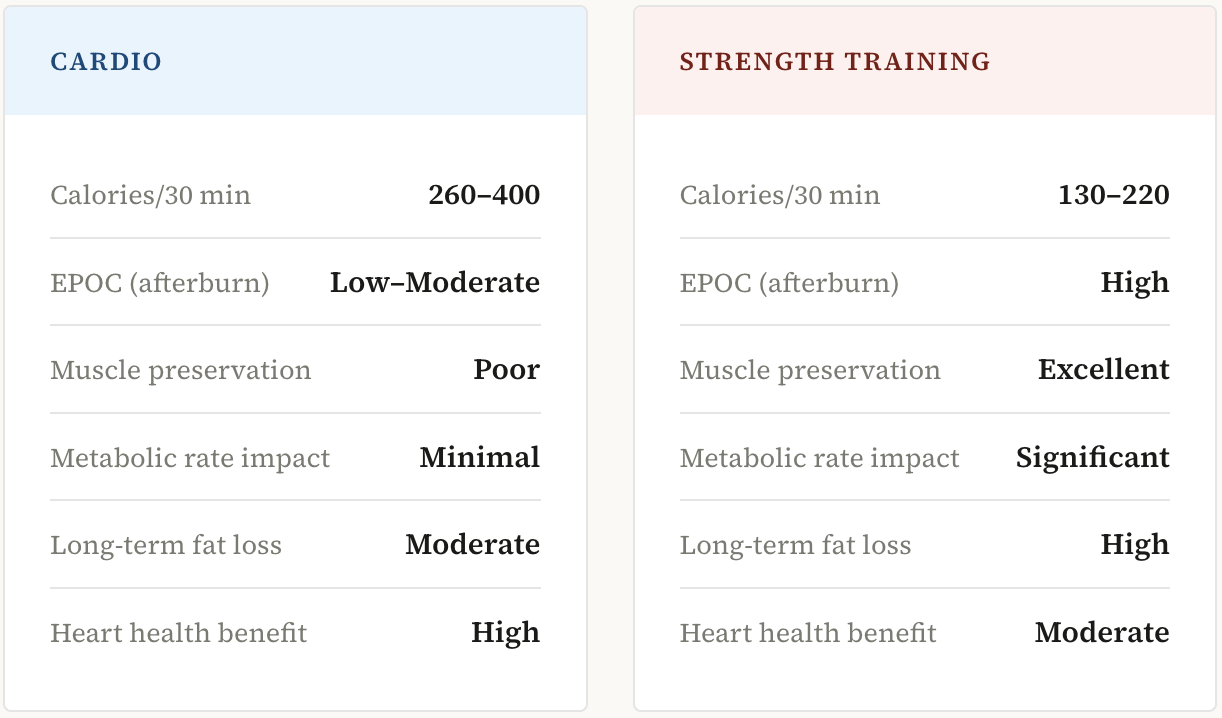
A 155-pound (70 kg) person burns approximately 260–400 calories during 30 minutes of moderate-to-vigorous cardio (think a brisk jog at 6 mph).
Compare that to roughly 130–220 calories for the same 30 minutes of weight training. On a session-by-session basis, cardio wins by a clear margin.
Fat oxidation during exercise
At lower to moderate intensities (roughly 50–70% of your maximum heart rate), your body preferentially burns fat as its primary fuel source.
This is the physiological basis for the much-discussed “fat-burning zone.” While it’s a real phenomenon, it doesn’t tell the whole story.
Total calories burned matter more than the percentage of those calories coming from fat.
Cardiovascular and metabolic health benefits
Beyond pure calorie burn, regular cardio improves insulin sensitivity, reduces visceral (belly) fat specifically, and enhances mitochondrial density all of which support a healthier metabolic environment for ongoing fat loss.
Best for
People who want the highest immediate calorie burn per session, those with cardiovascular health goals alongside fat loss, and beginners who aren’t yet comfortable with resistance training.
The Case for Strength Training
Strength training also called resistance training or weight lifting, burns fewer calories in the gym than a comparable bout of cardio.
So why do so many fitness professionals now argue it’s superior for fat loss? The answer lies in what happens after you leave the gym.
Muscle is a metabolically expensive tissue
Every pound of muscle you carry burns approximately 6–10 calories per day at rest, more than three times what a pound of fat burns.
Building muscle through consistent strength training gradually raises your basal metabolic rate (BMR), meaning you burn more calories around the clock, even while sitting, sleeping, and watching television.
Over months and years, this metabolic advantage compounds significantly. Someone who adds 5 lbs of lean muscle mass might burn an extra 30–50 calories per day at rest, modest on its own, but meaningful when sustained over time.
Preserving muscle during a caloric deficit
When you diet without resistance training, studies consistently show that 20–30% of the weight you lose comes from lean muscle mass, not fat.
This is metabolically disastrous: you lose muscle, your BMR drops, and fat loss becomes progressively harder.
Strength training signals to the body that it needs to preserve muscle tissue, keeping your metabolic rate higher throughout your fat-loss phase.
Best for
Long-term fat loss and weight maintenance, preserving lean muscle while dieting, improving body composition (the ratio of fat to muscle), and helping people who want a higher resting metabolic rate.
The Afterburn Effect (EPOC) Explained
One of strength training’s most compelling arguments is a phenomenon called Excess Post-Exercise Oxygen Consumption, commonly known as EPOC or more colloquially, the “afterburn effect.”
After a demanding workout, your body continues to consume oxygen at an elevated rate while it works to restore itself: replenishing energy stores, clearing metabolic byproducts, repairing micro-tears in muscle tissue, and rebalancing hormone levels.
All of this costs calories — and it continues for hours, or even days, after your workout ends.
High-intensity and heavy resistance training can elevate your post-exercise calorie burn by 6–15% above baseline for up to 38 hours after a session.
Steady-state cardio (like a 45-minute jog at a consistent pace) produces a relatively modest EPOC — perhaps an extra 30–80 calories post-workout.
High-intensity interval training (HIIT) and heavy compound lifting, by contrast, can produce significantly larger afterburn effects.
A 2002 study published in the European Journal of Applied Physiology found that EPOC from resistance exercise was greater in magnitude and longer in duration than that from aerobic exercise of similar intensity.
The practical takeaway
The calorie gap between cardio and strength training is smaller than it looks when you factor in post-exercise burn.
Body Composition: The Overlooked Variable
Most discussions of fat loss anchor on the scale — total pounds lost. This is a mistake. What matters more is body composition: the ratio of fat mass to lean mass.
Consider two people who each lose 10 lbs over 12 weeks:
- Person A does cardio only: loses 7 lbs of fat and 3 lbs of muscle.
- Person B does strength training with moderate cardio: loses 10 lbs of fat and gains 1 lb of muscle.
Person B looks leaner, is stronger, has a higher metabolism, and is far less likely to regain the weight. Person A weighs the same as Person B on the scale, but has a worse metabolic outlook going forward.
This is why strength training is increasingly recognized by sports scientists as the cornerstone of effective, sustainable fat loss particularly for people who have dieted and regained weight multiple times (a phenomenon called weight cycling, which progressively increases the proportion of fat in regained weight).
Cardio vs Strength Training: Side-by-Side
Combine Both: But Make Strength Training Your Foundation
Cardio burns more fat during a session. Strength training burns more fat over a lifetime.
The research consistently shows that combining both modalities produces superior fat loss outcomes compared to either approach alone.
A landmark 2012 study from Duke University (the STRRIDE trial) found that participants who performed both aerobic and resistance training lost significantly more fat, including dangerous visceral fat, than those who did only one type of exercise.
If you have to choose one, for pure, sustainable fat loss and body composition, strength training edges out steady-state cardio.
For cardiovascular health, endurance, or maximum calorie burn in minimum time, cardio wins. Most people should do both.
The Best Fat-Loss Routine in Practice
Knowing that a combined approach is optimal, here’s how to structure it in the real world:
Prioritize compound movements
Squats, deadlifts, bench press, rows, and overhead presses recruit multiple large muscle groups simultaneously, burning more calories and stimulating more muscle growth than isolation exercises.
Build your strength sessions around these movements for maximum fat-loss impact.
Use HIIT strategically
High-Intensity Interval Training combines the calorie-torching benefits of cardio with a strength-training-level EPOC response.
Short, intense bursts (20–40 seconds at near-maximum effort) followed by brief rest periods are highly time-efficient for fat loss.
Two to three HIIT sessions per week are typically sufficient more can impair recovery from strength training.
Don’t neglect steady-state cardio
Low-to-moderate intensity cardio (walking, cycling, swimming at a conversational pace) is easy on recovery, adds to your weekly calorie expenditure, and supports cardiovascular health.
Daily walks of 20–40 minutes are one of the most underrated fat-loss tools available. They don’t interfere with strength training recovery and are sustainable long-term.
Sample weekly structure
Example weekly plan
Monday: Strength training (lower body focus)
Tuesday: 20–25 min HIIT or 40 min moderate cardio
Wednesday: Strength training (upper body focus)
Thursday: Active recovery — walking, light cycling
Friday: Strength training (full body or lagging areas)
Saturday: 30–45 min moderate cardio
Sunday: Rest or gentle movement
Diet remains the primary driver
It bears repeating: exercise is powerful, but nutrition is the dominant variable in fat loss.
A moderate caloric deficit of 300–500 calories per day, built around adequate protein (0.7–1g per pound of bodyweight) to preserve muscle, will accelerate results from any exercise approach. You cannot out-train a poor diet.
Key takeaways
- Cardio burns more calories per session; strength training burns more fat long-term via a higher resting metabolic rate.
- Strength training is essential for preserving muscle during a caloric deficit — skipping it risks losing the tissue that keeps your metabolism elevated.
- The afterburn effect (EPOC) is meaningfully larger after resistance and high-intensity training than after steady-state cardio.
- Body composition not just total weight lost, is the metric that predicts long-term success and health outcomes.
- A combined program of strength training plus cardio outperforms either modality alone for total fat loss.
- Daily moderate activity (especially walking) is an underrated and sustainable addition to any fat-loss plan.
FAQ: Does Cardio or Strength Training Burn More Fat?
Does cardio or strength training burn more calories?
Cardio generally burns more calories during a session. A 155-pound person burns roughly 260–400 calories in 30 minutes of moderate-to-vigorous cardio, versus approximately 130–220 calories for the same 30 minutes of strength training.
However, strength training raises your resting metabolic rate over time, so the total calorie burn advantage narrows significantly when viewed across a full week especially once EPOC is factored in.
Is it better to do cardio or weights for belly fat?
Both help reduce belly fat, but you cannot spot-reduce fat from a specific area. Research suggests that combining cardio and strength training is most effective for reducing visceral (deep belly) fat specifically.
Cardio creates a meaningful caloric deficit, while strength training builds muscle that raises your metabolism so you burn more calories at rest, including from fat stores throughout the body.
What is the afterburn effect, and does it matter?
The afterburn effect (formally called Excess Post-Exercise Oxygen Consumption, or EPOC) is the elevated calorie burn that continues after exercise ends as your body restores itself to a resting state.
High-intensity and strength training produce a larger and longer-lasting EPOC than steady-state cardio, burning an additional 6–15% more calories in the hours after your workout.
It matters, though it’s not a magic bullet total session calories still dominate the equation.
How many days a week should I do cardio vs strength training?
For optimal fat loss and body composition, most fitness professionals recommend 2–4 days of strength training and 2–3 days of cardio per week.
These can be alternated on separate days or combined in the same session (with cardio performed after weights to preserve strength training performance).
Daily low-intensity activity like walking can be added freely without impacting recovery.
Should I do cardio before or after lifting weights?
Research suggests doing cardio after your strength training session for most goals. Performing heavy lifting first, while glycogen stores and neuromuscular freshness are at their peak, maximizes strength and muscle-building stimulus.
Cardio afterward can still be effective for fat burning. The exception is if you’re training primarily for endurance performance, in which case cardio first may be appropriate.
Disclaimer
This article is for informational purposes only and does not constitute medical or professional fitness advice.
Consult a qualified healthcare provider before beginning any new exercise program, especially if you have existing health conditions.